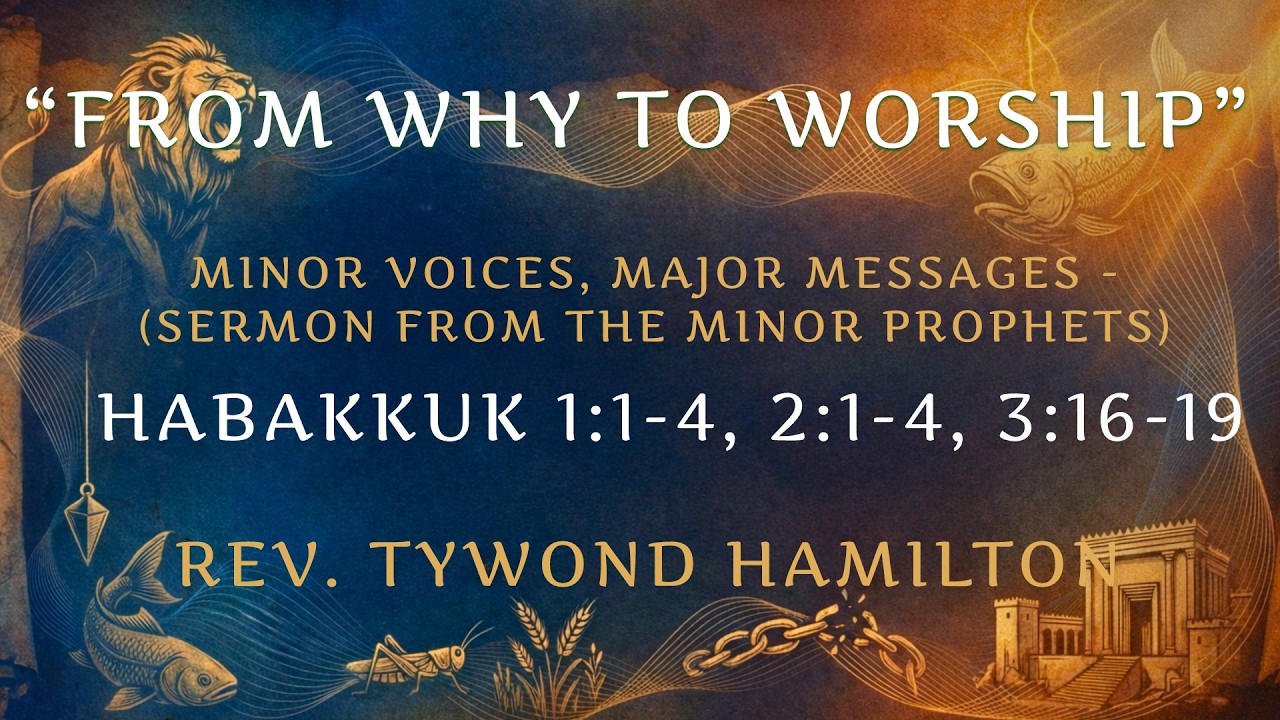
Editorial summary · introduction
Imperfect people remain usable and necessary
Reverend Tywond Hamilton opens by treating the Old Testament as a record of real human experience. God's perfect will repeatedly works through imperfect people, so background, family history, failure, and struggle cannot erase a calling.
That conviction establishes the sermon's pastoral posture toward Habakkuk. The prophet's questions are not mocked or hidden; they become the starting place for a movement toward honest prayer, patient listening, faith, and worship.
- 1:10:44The Old Testament opens human experience through people God used for divine purposes despite their imperfections.
- 1:11:30The preacher applies that pattern personally: a flawed background does not disqualify anyone from being used by God.
- 1:12:06Family history, adoption, or an upbringing unlike someone else’s does not determine the limits of a person’s calling.
- 1:12:26Painful experiences can shape and define people for the work God is calling them to do.
- 1:13:04Biblical people who were dismissed by others become evidence that God can change a life and use it for glory.
- 1:13:19Every person is important in God’s sight and carries a mission and purpose.
- 1:13:36Every member has something distinct to add to the church body—something another member, or even the preacher, cannot supply.
- 1:14:08Different temperaments belong in ministry; seriousness and lightness can serve one another instead of becoming reasons for dismissal.
Editorial summary · sermon movement
The movement from why to worship
The sermon follows Habakkuk's own progression across chapters 1, 2, and 3. Open each division for the complete timestamped summary of its reasoning, illustrations, applications, and transitions.
011:14:41Who are you talking to?
Editorial summary
Habakkuk 1 is presented as an honest conversation between the prophet and God about a world in disorder. The preacher does not condemn the prophet’s questions; he treats them as a recognizably human response to corruption, violence, broken families, and the apparent triumph of sin.
The pastoral turn is about direction. Questions, frustration, and confession should be taken to God before they are broadcast to other people. Honest prayer does not hide the believer’s failure or feeling, but it must finally return to trust in God and the authority of God’s word.
Judah’s disorder and Habakkuk’s human experience
The prophet looks at the southern kingdom of Judah and sees disorder at public and domestic levels. His repeated question arises because righteousness appears to be losing while sin appears to be winning.
Timestamped editorial summary
- 1:14:41The book is framed as Habakkuk speaking to God about what is wrong in the world rather than addressing a congregation.
- 1:15:13Chapter 1 begins the sermon’s movement from why to worship with the prophet asking God why.
- 1:15:21The preacher names corrupt government, mistreatment, and killing as features of Judah’s crisis.
- 1:15:36The crisis also reaches the household: fathers are absent, mothers do not take time with children, and family structure has broken down.
- 1:16:01Habakkuk’s question is why God has not fixed what the prophet can plainly see.
- 1:16:22A remembered pastoral lesson reframes the search for explanations: knowing God matters more than possessing every answer.
- 1:16:44The congregation is urged not to shame people merely because they are having a human experience.
- 1:17:23Habakkuk’s distress grows from the feeling that sin is winning and righteousness is losing.
Take the complaint to God and be honest there
What distinguishes Habakkuk is not the absence of complaint but its destination. He goes to the source, speaks honestly, and leaves room for God to address both the world’s wrong and the prophet’s own heart.
Timestamped editorial summary
- 1:17:37The biblical record does not show Habakkuk circulating complaints among the church people about what he thinks God has done wrong.
- 1:18:02Instead of spreading the complaint, Habakkuk goes straight to God.
- 1:18:08Prayer is presented as a place for honesty because God is strong enough to receive the truth about human feeling and conduct.
- 1:18:21Honest confession admits what was said, how someone was treated, and where the heart needs help.
- 1:19:16Human experience may include stress and frustration, but the decisive question is where the believer’s mind rests at the end of the day.
- 1:19:38The required return is to trust God above present feeling and to value God’s word above the immediate situation.
- 1:19:58The preacher sharpens the application with a direct question about who receives the believer’s complaint.
- 1:20:12Impatience with an unanswered request is not a reason to tell the world what one thinks is wrong with God; it is a reason to go to God.
Make God the first relational destination
A marriage illustration explains why order matters in intimate relationships. Going first to the one with whom the relationship is deepest communicates trust, priority, and dependence; the preacher applies that same order to prayer.
Timestamped editorial summary
- 1:20:28The governing question returns: who are you talking to when trouble arises?
- 1:20:39Bringing the problem to God before anyone or anything else magnifies God and gives God first place.
- 1:20:56The preacher recalls discussing a personal matter with someone else before his wife knew about it.
- 1:21:30His wife’s hurt becomes an illustration of how relational priority is communicated by whom one tells first.
- 1:21:47He later taught his married son to tell his wife about a medical concern before calling his parents.
- 1:22:06Speaking to God first declares that God is the first One on whom the believer depends.
- 1:22:27After God, the preacher directs people toward someone who is praying for them and will carry the concern back to God.
- 1:22:48The church is warned against telling on people to other people when it should be telling God about them.
- 1:23:02Habakkuk models the entire movement by going directly to God and naming how the situation feels.
021:23:09Put yourself in a position to hear from God
Editorial summary
Habakkuk 2 shifts from speaking to listening. The prophet chooses an ‘I will’ posture, returns to his watch, and places himself where he can hear God. Prayer is therefore more than expression; it includes silence, continued obedience, and attention.
The watchtower image also becomes a ministry and discernment image. Remaining in one’s God-given place makes it possible to recognize approaching danger, receive correction, and distinguish the enemy’s voice from God’s direction.
Choose the watch even when obedience does not feel good
The first ‘I will’ is a decision to choose God’s way despite the surrounding culture’s demand for immediacy and despite the believer’s present emotions.
Timestamped editorial summary
- 1:23:09The sermon turns from Habakkuk’s complaint in chapter 1 to his chosen posture in chapter 2.
- 1:23:19The phrase ‘I will’ is treated as a deliberate choice of God regardless of feeling.
- 1:23:33God’s way often conflicts with a world that insists every desire must be satisfied immediately.
- 1:24:08After telling God the complaint, Habakkuk chooses to stand on his watch and set himself on the tower.
- 1:24:24The tower is summarized as a position from which Habakkuk can hear God.
- 1:24:42Having brought the problem to God, the prophet returns to what he has been called to do.
- 1:25:04Ministry participants who stop attending, meeting, and serving remove themselves from the position where they expect direction.
The tower as a quiet place for listening
Because the elevated watch was quiet and unobstructed, it supplies a model for private prayer that includes stillness after speech. The believer asks, then makes room for the Holy Spirit to answer.
Timestamped editorial summary
- 1:25:23The watchman’s tower rises above the walls and gives a long, clear field of vision.
- 1:25:36Its quietness makes it a place where the prophet can hear God.
- 1:25:50Prayer is not defined only as continuous talking.
- 1:26:04The preacher recommends ending private petitions with ten or fifteen minutes of quiet.
- 1:26:16That silence is presented as space in which the Holy Spirit can speak.
Remain in the calling until God moves you
Waiting for an answer does not suspend purpose. A personal testimony about moving from choir ministry to the deacon ministry teaches that self-directed movement can pull a person downward, while God-directed movement raises and reassigns at the right time.
Timestamped editorial summary
- 1:26:20Habakkuk’s posture joins urgent need with a refusal to stop doing what God called him to do.
- 1:26:31The application is explicit: do not abandon a ministry assignment without first hearing from God.
- 1:26:40The preacher recalls wanting to leave the choir during the season when God was calling him to preach.
- 1:26:49Jacque Smith advised him not to move himself, warning that self-movement goes down while the Lord’s movement goes higher.
- 1:27:01The pastor’s request that he become a deacon resolved the decision without his forcing it.
- 1:27:14The testimony becomes a rule of discernment: let the Lord choose when and how to leave an assignment.
A faithful watch reveals danger before it arrives
The watchtower is not only quiet; it is protective. Spiritual disciplines and continued participation prepare the believer to recognize temptation, relationships, and other dangers before they become close enough to overwhelm.
Timestamped editorial summary
- 1:27:32From the tower, watchmen can see an enemy while the threat is still far away.
- 1:27:48Seeing the enemy early allows the watcher to prepare for the approach.
- 1:27:53In the quiet place and the place of calling, God can warn against a destination, word, drink, or decision.
- 1:28:20The preacher repeats a pattern of praying for deliverance while continuing in church, Sunday school, Bible class, and worship.
- 1:28:46Continued presence keeps the believer where God can answer and where danger can be seen.
- 1:29:01Spiritual blindside is connected to being absent from the place of listening and preparation.
- 1:29:22Hearing the Holy Spirit supplies relational discernment when persuasive words conceal the wrong person.
- 1:30:10Exercising faith may feel wrong at first, but pushing through feeling makes room for God-given strength on the other side.
Listen for correction as well as comfort
Habakkuk expects that God may reprove him. The sermon treats this openness as essential to answered prayer: the prophet goes to God first, remains in his calling, and is willing to hear what must change in himself.
Timestamped editorial summary
- 1:31:29People called to teaching and ministry may avoid the place of listening because God’s voice exposes what must change.
- 1:32:11Habakkuk returns to the tower to listen for God’s answer after praying.
- 1:32:22His readiness to be reproved means he is willing for the answer to include correction of his own conduct.
- 1:32:49The congregation is asked whether it genuinely approaches God wanting to hear the truth about itself.
- 1:33:11A circle in which no one can offer truthful correction is presented as spiritually inadequate.
- 1:33:27Truth must be spoken in love, but spiritual friendship must still be able to name what is wrong.
- 1:33:38The desire for an uplifting church experience cannot replace repentance when sin needs to stop.
- 1:34:18God’s answer follows a sequence of honest prayer, continued calling, and willingness to receive correction.
- 1:34:53The preacher’s own life changed more deeply when he became honest with himself.
031:34:56The vision is going to come, but not in your timing
Editorial summary
God’s answer is to be made visible and shared, but its fulfillment belongs to an appointed time. The apparent contradiction between tarrying and not tarrying is resolved as a distinction between human timing and God’s timing.
Waiting is applied pastorally to healing, deliverance, addiction, and Christian community. Some change is immediate, while other change requires patient, honest participation over weeks or years.
Make the vision plain and let the life display it
Writing the vision is explained through public visibility: a billboard, the church screens, and ultimately a recognizable Christian life. Witness does not require constant public preaching; consistent conduct can make others ask what is different.
Timestamped editorial summary
- 1:34:56God’s answer begins with the instruction to write the vision and make it plain.
- 1:35:07The preacher translates the instruction into placing the word where it can be plainly seen.
- 1:35:20Visibility allows the person who sees the message to run with it and share it.
- 1:35:26Believers are urged not to hide their identity or be ashamed of faith.
- 1:35:34The witness can be lived rather than shouted, allowing distinct conduct to become visible in ordinary settings.
- 1:36:01When others recognize the difference and ask about it, the believer has an opening to explain its source.
Tarrying belongs to human perception; fulfillment belongs to God’s appointment
The preacher works through the language of waiting and explains that the promised action may feel delayed without being late. The danger is abandoning faith only steps before the expected blessing.
Timestamped editorial summary
- 1:36:13Habakkuk 2:3 introduces a vision set for an appointed time and commands the hearer to wait.
- 1:36:28The preacher pauses over the tension between a vision that tarries and one that will not tarry.
- 1:36:54The resolution is that the vision will come, but not according to the prophet’s timing.
- 1:37:01A personal pattern of impatience is described: waiting almost to the blessing and then turning away at the last moment.
- 1:37:24Deliverance is promised without being placed on the timetable the hearer expects.
- 1:37:36The appointed time is the time God has chosen for fulfillment.
Healing, deliverance, and habit change may unfold gradually
The appointed-time principle is brought into the life of the church. People should not be shamed when long-developed habits do not disappear in two weeks; the question is whether they remain where change can be learned and whether they keep working toward freedom.
Timestamped editorial summary
- 1:37:47Healing and deliverance are named as processes that can take time.
- 1:37:56The church is presented as the place where a person can learn the way of deliverance rather than hide the need.
- 1:38:03Some deliverance is immediate, while entrenched habits may require weeks or years of work.
- 1:38:18The congregation is warned against expecting someone with decades of sin or addiction to be fully changed in two weeks.
- 1:38:25The preacher’s cigarette addiction supplies a personal example of a habit that could not be stopped overnight.
- 1:39:01He traces gradual reduction until the desire finally lost its hold.
- 1:39:32Honest community allows someone to admit the former struggle and testify that grace carried them through it.
041:39:50Yet I will rejoice
Editorial summary
Habakkuk receives an answer, but it is not the answer he wanted: God will use the Chaldeans to judge Judah. Chapter 3 therefore does not begin with favorable circumstances. It begins with trembling and with obedience that must proceed through fear.
The sermon’s final turn is a chosen ‘yet.’ Worship is not denial that the fig tree, vine, field, flock, and stall have failed. It is confidence in God’s character, self-encouragement in faith, and trust that the Holy Spirit supplies strength for purpose.
God’s answer may arrive through an unexpected order
The prophet’s complaint is answered through the Chaldeans, a people who do not honor God. The application is to release the demand to know or control the method by which God acts.
Timestamped editorial summary
- 1:39:50The move to Habakkuk 3 begins after the question has been answered at God’s appointed time.
- 1:40:01The preacher stresses that God’s answer was not the answer Habakkuk had been seeking.
- 1:40:15God will use the Chaldeans to judge the sin and destruction in Judah.
- 1:40:25Habakkuk struggles with God using unbelieving people against people who believe but are living in sin.
- 1:40:39The congregation is told not to make trust depend on understanding exactly how God will act.
- 1:41:47God does not always work in the sequence the believer has planned.
Do the will of God even while afraid
Habakkuk’s trembling is not treated as unbelief. Fear can coexist with faithful action; the preacher’s own terror in preaching illustrates doing what God called him to do because of the call rather than because it feels comfortable.
Timestamped editorial summary
- 1:41:52Hearing how God will judge Judah causes Habakkuk to tremble.
- 1:42:08The sermon turns that fear into counsel to do God’s will even when the believer is scared.
- 1:42:14Preaching is named as one of the most terrifying assignments the preacher has undertaken.
- 1:42:29Calling, not comfort, becomes the reason to proceed.
- 1:42:38The congregation is urged to obey through fear and nervousness.
- 1:42:56Faith is required because the will of God will not always feel enjoyable after a lifetime shaped by the world.
- 1:43:05The just living by faith is applied as trust in God regardless of appearance or feeling.
- 1:43:19Habakkuk’s posture is summarized as willingness to do what God requires while still afraid.
Get a ‘yet’ in your spirit and encourage yourself
The repeated ‘I will’ is read as Habakkuk speaking to himself. He does not wait for emotion or circumstance to change before choosing rejoicing; he directs his own heart toward faith, repentance, and worship.
Timestamped editorial summary
- 1:43:30The repeated ‘I will’ is identified as Habakkuk talking to himself.
- 1:43:43Self-encouragement in the Lord answers the combination of fear and worry.
- 1:43:54The preacher models personal self-address that insists faith can endure and sin can be left behind.
- 1:44:12The congregation is urged to receive a ‘yet’ that chooses rejoicing before the conditions improve.
- 1:44:26This chosen rejoicing completes the movement from why to worship.
- 1:44:35Habakkuk is described as keeping a posture of purpose until the prayer is answered.
Faith sustains life when life makes no sense
Faith is distinguished from pretending that everything is fine. It is confidence placed in God’s character, and the fish-in-water illustration shows faith as the environment that sustains the righteous person through trouble.
Timestamped editorial summary
- 1:44:53The preacher pauses over the church’s discouragement and the need to leave worship stronger than one entered.
- 1:45:25Faith is defined as confidence in God’s character when life does not make sense, not a pretense that life is fine.
- 1:45:38Faith is further described as the sphere that sustains a righteous person’s life.
- 1:45:48A fish living in water illustrates how an environment sustains the life within it.
- 1:46:13In the same way, faith should carry the believer through what is being endured.
- 1:46:20A ‘yet’ and an ‘I will’ are presented as sustaining language that helps the believer make it through.
A communal ‘yet’ joins history to present struggle
The close widens from personal endurance to Black survival through enslavement, harm, and Jim Crow. That history becomes the ground for contemporary declarations over children, marriage, addiction, and diminished faithfulness.
Timestamped editorial summary
- 1:46:33The preacher invokes four centuries of Black suffering and endurance as a history of continuing faith.
- 1:46:45The repeated conclusion of that history is survival: despite what was done, the community is still here.
- 1:46:57Concern for a child is answered with hope that the child can still become great.
- 1:47:03A shaking marriage is answered with confidence that God can deliver the relationship.
- 1:47:09Addiction is answered with a continued choice to trust God.
- 1:47:14A decline in faithfulness is not treated as the final state; it becomes another place to say ‘yet.’
- 1:47:23Black resilience is presented as evidence that repeated attempts to break a people have not had the last word.
- 1:47:31The communal response remains a declaration of trust in the Lord.
The Holy Spirit supplies strength for purpose
Habakkuk’s final image of hind’s feet becomes a promise of spiritual spring and forward movement. Trust strengthens, motivates, and equips a person to keep doing the purpose God has given.
Timestamped editorial summary
- 1:47:40The final verses move from rejoicing to the strength God gives.
- 1:47:43Hind’s feet supply the biblical picture of sure and strengthened movement.
- 1:47:50A familiar energy-drink slogan is recast: the Holy Spirit supplies spring rather than wings.
- 1:47:56Trust in the Lord encourages, motivates, and strengthens the believer to fulfill purpose.
- 1:48:09The conclusion returns to choosing God regardless of present feeling.
- 1:48:20The sermon title is repeated as the required movement away from complaint and toward worship.
- 1:48:31Appearance and feeling do not control the final response.
- 1:48:39The sermon ends with the chosen response of rejoicing in the Lord.
Editorial summary · highlights
Key sermon moments
These concise summaries mark the sermon's central pastoral and theological turns.
- 1:16:22Knowing God is presented as better than possessing an explanation for every painful circumstance.
- 1:18:08Honest prayer takes the unedited human experience to a God strong enough to receive it.
- 1:20:39Going to God first communicates that God holds first place in the believer’s dependence.
- 1:24:24Answered prayer requires a posture that is positioned to hear, not only a voice that knows how to speak.
- 1:26:08Private prayer includes intentional quiet in which the Holy Spirit can speak.
- 1:26:49The calling testimony warns against moving oneself before God gives the direction to move.
- 1:29:22Spiritual attentiveness makes discernment possible before temptation or the wrong relationship comes close.
- 1:32:22Listening for God includes readiness to be corrected, not merely comforted.
- 1:36:54The vision’s arrival is certain, but its timing belongs to God.
- 1:38:18The church must make room for patient transformation instead of demanding instant repair of decades-old patterns.
- 1:42:08Fear does not cancel obedience; the will of God can be done while the servant is still scared.
- 1:44:26Purposeful, self-directed rejoicing becomes the decisive turn from why to worship.
- 1:45:25Faith is confidence in God’s character when circumstances do not make sense, not denial of those circumstances.
- 1:46:33Black survival through historic oppression becomes a communal testimony that suffering has not erased faith.
- 1:47:56The sermon closes with strength not as an end in itself but as provision for carrying out God-given purpose.
Editorial summary · invitation
Choose Christ, bring the burden, and return to purpose
The invitation joins conversion and pastoral prayer. Those who need Christ are invited to choose Him, while believers carrying trouble are invited to bring it to God, leave it there, and continue in purpose while waiting for an answer.
- 1:48:45The transition from sermon to invitation asks the congregation to stand and opens the doors of the church.
- 1:48:53Anyone who needs to choose Jesus as Savior is invited to respond.
- 1:49:08The invitation includes those who identify with the prophet’s question because the world and their circumstances feel hostile.
- 1:49:18Hearers are invited to accept Jesus Christ personally.
- 1:49:26Believers already in the faith but carrying a present struggle are invited to receive prayer.
- 1:49:46Whatever is in the heart can be brought to the altar and given to God.
- 1:49:56The final instruction is to leave the burden with God and return to one’s purpose while waiting for the answer.